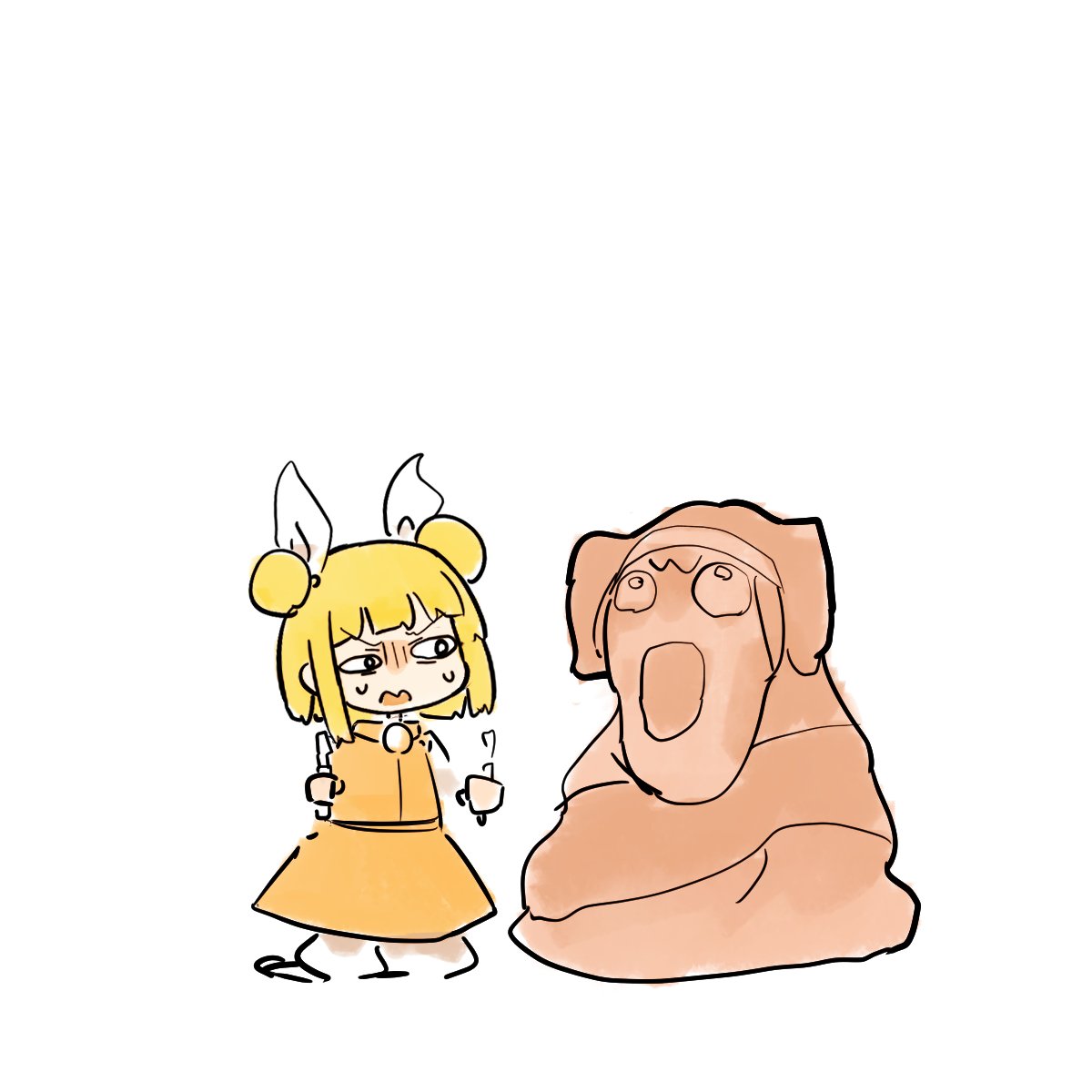
The Anatomy of a Haniwa Vanilla_Enthusiast!AdF3bWaDQs 2026/09/17 (Thu) 11:36
No. 3411
▼
File
17896450013.jpg
- (80.33KB,
720x706,
Illustration of the Sculptor Goddess-Keiki Haniyas.jpg)

It has been the author's intention to reduce the burden of other curious people trying to study the fascinating complexity of a haniwa, and to achieve this, we aimed to shorten the text to about a third of the length found in standard texts. The shortening was to be achieved by brevity, the omission of repetition, and by the very extensive use of simple illustrations in the belief that ‘a little picture is worth a million words.’ Much repetition has indeed been avoided, and the book is little less than half the length of its original scripture.
It is doubtful, however, if the pictures intended to ease said burden are enough to provide a complete understanding of the anatomy of a haniwa, as its simplicity may have excluded some important details, and opting to use more detailed illustrations would not only cost more, but may also deter other enthusiastic researchers trying to grasp the concept. It is a general criticism of the book. The picture illustrating the neuromuscular control of the pupil of a warrior haniwa is itself necessarily complex, rivaling the Gensokyo map in complexity and is on too small a scale to allow easy understanding or even recognition of its parts.
It is unlikely that such figures as this will lighten any person’s burden in their pursuit to study a haniwa, although careful study of them, if sufficiently prolonged, will be worth while.
Vanilla_Enthusiast!AdF3bWaDQs 2026/09/17 (Thu) 11:50
No. 3413
▼
General Introduction
The term anatomy is a consideration of various structures which make up an organism. A haniwa’s anatomy, just like human anatomy, is predicated on the idea that the body has a clinically insightful story to tell. It is clear that their anatomy is mostly inspired, if not copied, from humans. Just as humans have evolved, haniwa’s design has also evolved over time to further improve their performance. There are two main categories for their model, one from the old times of war where the Sculptor Goddess is still experimenting with their design, and one from the more recent times where the Goddess had (almost) conquered the Animal Realm and further improved their design.
As said above, the framework of haniwa is mostly similar to the human skeleton. The vertebrae of a haniwa are divided into four different regions, being the cervical spine, thoracic spine, lumbar spine, and the sacrum. In haniwa, it is composed of 29 vertebrae that include 7 cervical, 12 thoracic, 5 lumbar, and 5 sacral. As opposed to humans, however, a haniwa’s spine does not include the coccyx region, as their goddess had deemed that having a tailbone on a creature with no tail would be unnecessary.
Another main distinction of their anatomy is that they do not have a central nervous system. Unlike a human’s nervous system, a haniwa does not possess a brain, as their whole nervous system is spread across their whole body through interconnected threads. These threads act as both their muscles and their nerves, so it would be more appropriate to refer to them as one singular system known as the “neuromuscular system”. Because of this, they are capable of functioning normally even after losing 2/3 of their head from a vigorous battle. Do note that most of these threads are still interconnected to the head, specifically the neck, so cutting their heads off completely can still incapacitate them to a degree.
There are two types of strings used for their neuromuscular system, each string designed to fit the haniwa's purpose. Haniwa with the purpose of storing and generating ideas used glass fibers, as their sensitivity makes them more receptive to stimuli, allowing them to learn and adapt faster with each new piece of information they get. Haniwa that are designed for battles are created with hard, sturdy, and flexible strings such as aramid fibers. This allows their body to withstand massive amount of pressure, giving them more strength than a regular haniwa.
Anonymous 2026/09/17 (Thu) 12:20
No. 3414
▼
File
178964763624.jpg
- (74.80KB,
1200x1200,
811dd22ad1a677b7cc78d1b3722dc235.jpg)
Who else reading this for the first time the night before the exam